
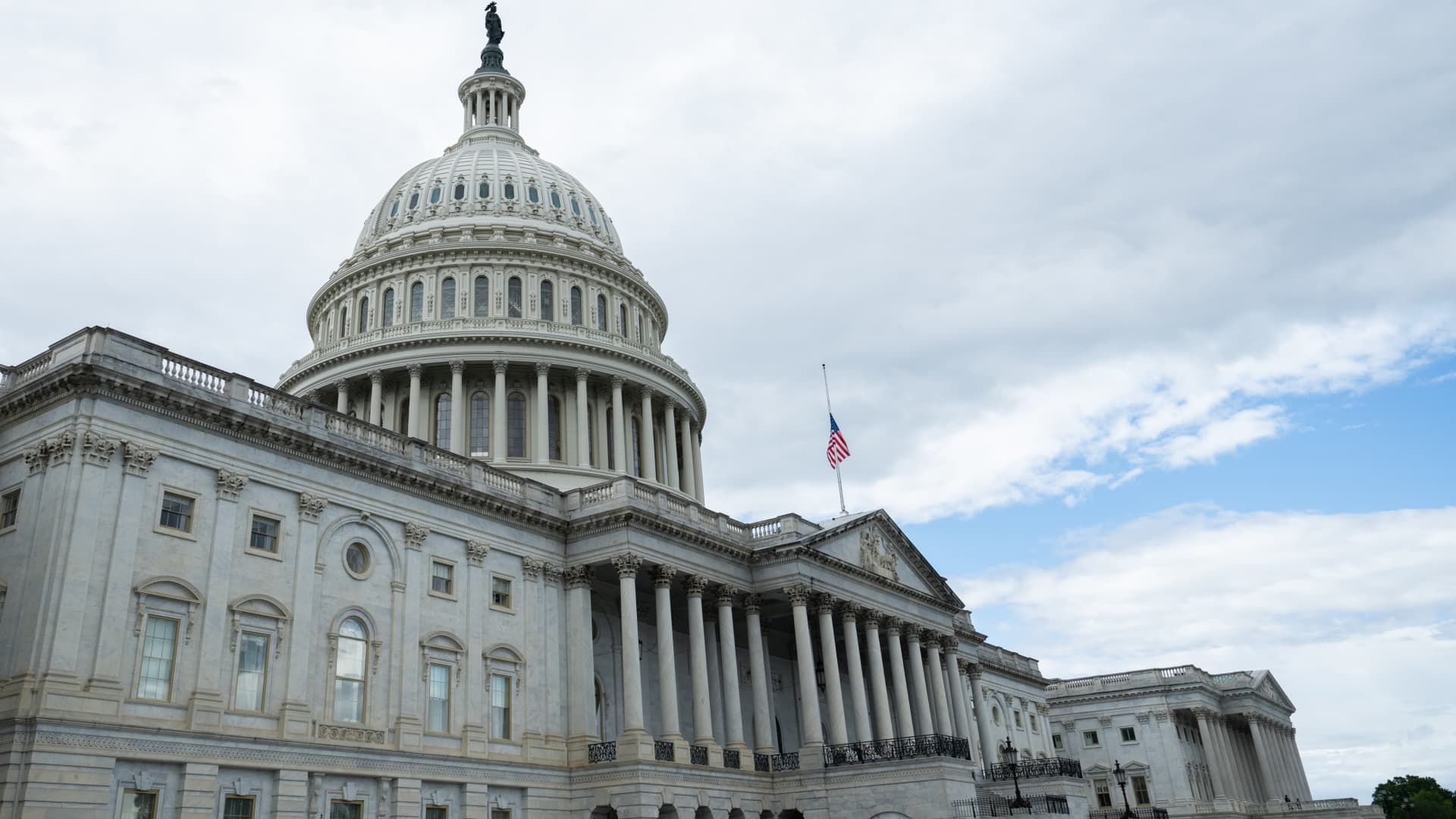
Annabelle Gordon/Bloomberg via Getty Images
Well, it seems House Republicans have outdone themselves, stamping out a tax cut package so big it might as well come with a complimentary set of credit cards for the American people. Passed in May, this package is expected to crank up the U.S. debt by trillions—because who doesn’t love a little financial thrill ride?
The Committee for a Responsible Federal Budget estimates that this magical bill will add approximately $3.1 trillion to the national debt over the next decade. And just to spice things up, the Penn Wharton Budget Model suggests we might be looking at a jaw-dropping $3.8 trillion, factoring in interest and the overall feel-good vibes from the economic effects.
Rep. Thomas Massie of Kentucky took the plunge and voted against the House bill, dubbing it a “debt bomb ticking”—which sounds more like the plot of a low-budget action movie than a serious legislative initiative. Massie noted that it “dramatically increases deficits in the near term,” which is a wild understatement given the circus taking place on Capitol Hill.
“Congress can do funny math—fantasy math—if it wants,” he stated during his shine in the limelight on May 22. “But bond investors don’t.” Turns out they prefer their math with less drama and more clarity, who would have guessed?
A few Republican Senators, no strangers to the reality-friendly math club, have also raised their eyebrows regarding the bill’s potential impact on U.S. debt. “The math doesn’t really add up,” Sen. Rand Paul said Sunday on CBS, channeling his inner accountant as he tried to make sense of this fiscal jigsaw puzzle.
While the average citizen might think the national debt is just an abstract number floating in the ether, economists argue it can actually hit home—like a bad hangover after a night of indulgence. “I don’t think most consumers think about it at all,” said Tim Quinlan, a senior economist at Wells Fargo Economics. “But I think the truth is, it absolutely does.” Yes, Tim, but that would require them to pay more attention to money matters—especially when that means it might impact their takeout orders.
Consumer Financing: The Cost of Living Goes Up
Ah, but here comes the real kicker! That growing U.S. debt load is likely to send consumer financing costs soaring. Mark Zandi, chief economist at Moody’s, expects consumers to “pay a lot more” to finance homes, cars, and those extravagant $5 coffees everyone has grown so fond of.
“That’s the key link back to us as consumers, businesspeople, and investors,” he elaborated, as if revealing the secret menu at a gourmet coffee shop. “The prospect that all this borrowing and rising debt means higher interest rates.” Who needs inflation when you’ve got debt racking up like an overdue library book?
The cost-cutting measures in the House bill include slashing about $4 trillion in taxes—mostly benefiting those wealthy households that don’t mind lighting cigars with $100 bills. This is offset by cuts to safety-net programs like Medicaid and food assistance for those who might actually need their benefits. So kind of a Robin Hood scenario, if Robin was exclusively taking from the poor and giving to the rich.
But don’t worry; some Republicans and White House officials believe Trump’s tariffs will do a magic trick and offset these enormous tax cuts. Sure, because who doesn’t want to rely on unreliable revenue streams—just like that mysterious uncle who promises to pay back his loans in “favors.”
How Rising Debt Affects Treasury Yields
U.S. Speaker of the House Mike Johnson (R-Louisiana) is seen here after the House barely passed a bill forwarding President Donald Trump’s agenda at the U.S. Capitol on May 22, 2025.
Kevin Dietsch | Getty Images News | Getty Images
Ultimately, when it comes to consumer interest rates, it all boils down to perceptions of the U.S. debt and their effects on U.S. Treasury bonds—those fancy pieces of paper you can have if you like your savings a little less accessible.
Mortgage and auto loan rates are set based on yields from U.S. Treasury bonds, especially the 10-year Treasury.
Yields dance up and down like a toddler on a sugar high, dictated by market forces—demand, supply, and everyone’s desire to take on financial risk with a side of concern for timely bill payment.
How Debt Impacts Consumer Borrowing
Zandi dropped a rule of thumb that makes it sound simpler than it actually is: the 10-year Treasury yield typically rises about 0.02 percentage points for each 1-point increase in the debt-to-GDP ratio. So, if that ratio were to leap from 100% to 130%, consumers could see a yield rocketing up by around 0.6 percentage points—like a financial rollercoaster ride no one asked for.
To put this in perspective, a fixed 30-year mortgage could jump from nearly 7% to about 7.6%—pushing the dream of homeownership further out of reach, especially for would-be buyers hoping to enter the ranks of adulthood. The assumption of a $400,000 mortgage suddenly takes on the vibes of a game of Monopoly gone wrong.
Bond Investors: The Silent Victims
And let’s not forget about the folks who hold bonds—those innocent bystanders in this fiscal chaos. When Treasury yields increase, the market value of existing bonds falls faster than a bad reality TV show—as if it were following the plot twist no one wanted.
“If the market interest rate has gone up, your bond has depreciated,” advised Chao. “Your net worth has gone down.” So, if you see your investment portfolio looking a little less robust, just remember—it’s not you, it’s the bond market.
Pouring Gasoline on the Financial Fire
Financial analyst Quinlan pointed out that consumer financing costs have approximately doubled over recent years, much like the price of that fancy avocado toast. The average yield on the 10-year Treasury hovered around 2.1% only to shoot up to about 4.1% from 2023 onward—classic unpredictable market behavior.
While the U.S. debt is just one of many culprits in this financial drama, Quinlan aptly noted, “It’s not crazy to suggest financial markets have grown increasingly concerned about debt levels.” And indeed, without intervention, the debt will continue to spiral upward, giving a whole new meaning to the concept of sky-high costs.
Chao put it bluntly: the legislation could very well be “pouring gasoline on the fire” of our existing debt crisis. “It’s adding to the problems we already have,” he quipped, confirming that Congress truly knows how to throw a great financial party—at everyone else’s expense.
